High pressure water blasting is one of those industrial cleaning methods that looks almost too simple to work as well as it does. Water, pushed through a nozzle at extremely high pressure, removes deposits that resist every other cleaning approach available. Scale built up over years inside heat exchangers. Hardened concrete on construction equipment. Thick grease in industrial drain systems.
Rust and old coatings on structural steel. All of it comes off cleanly and without chemicals when the right water blasting techniques get applied by people who know what they’re doing. At Great Lakes Power Vac, high pressure water blasting is a core part of what we do for industrial clients and the results we see on jobs that looked almost impossible before we started are consistently what keep clients calling us back.
What High Pressure Water Blasting Actually Is
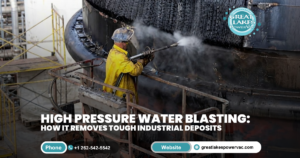
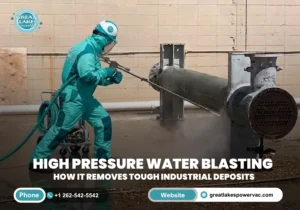
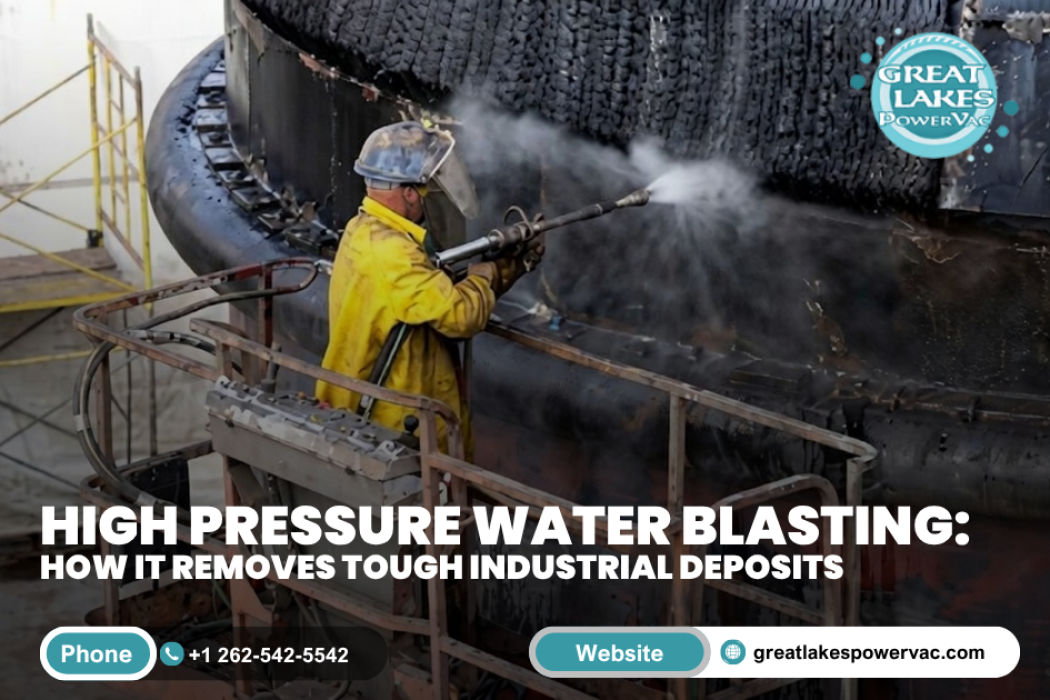
High-pressure water blasting uses a pump to force water out through a small nozzle at very high velocity. The focused stream strikes the target surface with sufficient intensity to break up and dislodge deposits that have adhered to the surface.
Cleaning results from the water’s kinetic energy acting against the scouring material. In most applications, there is no abrasion, no chemicals, no heat. Once the water begins moving at the required speed, it does the work.
Depending on the application, the pressure level varies. Industrial water blasting at 5000 PSI is the most affordable. Applications requiring ultra-high pressure work at over 25,000 PSI. The ideal pressure for a job will depend on what is being removed, what the underlying surface is, and what level of access is available to the area being cleaned.
How Industrial Deposits Form and Why They’re Difficult to Remove
The reason why deposits are hard to remove explains why often the only method that works is high pressure water blasting.
The mechanisms by which industrial deposits form differ according to environment and materials.
Scale and mineral deposits
Scale and mineral deposits form when water with dissolved minerals evaporates or undergoes temperature changes inside equipment like heat exchangers, boilers, and cooling towers. The minerals precipitate out and bond to metal surfaces as hard crystalline layers. These layers grow over time and can reach significant thickness that seriously impairs heat transfer and fluid flow.
Carbon and grease deposits
Carbon and grease deposits accumulate in industrial drain systems, exhaust components, and anywhere that oils and organic materials break down under heat. They polymerize and harden into deposits that resist mechanical scrubbing and standard chemical cleaners.
Concrete and cementitious deposits
Concrete and cementitious deposits bond quickly and firmly to equipment surfaces. Construction machinery, mixing equipment, and anything near concrete pouring operations develops buildup that hardens to near-concrete strength if it isn’t removed promptly.
Corrosion products and old coatings
Corrosion products and old coatings develop on structural steel, pipelines, and industrial equipment over time. Rust, mill scale, and multiple layers of old paint create surface conditions that need aggressive removal before any protective treatment or new coating can be applied effectively.
All of these deposit types share one characteristic. They have bonded strongly to the underlying surface in ways that make mechanical scrubbing ineffective and chemical treatment slow, expensive, or environmentally problematic.
How High Pressure Water Blasting Removes Each Deposit Type
The mechanics of how water blasting removes different deposits varies slightly but the underlying principle stays the same.
For scale and mineral deposits, the high velocity water penetrates micro-cracks in the crystalline structure of the deposit. The impact force and the rapid pressure change at the surface create a shockwave effect that fractures the deposit from the inside. The water then carries the broken fragments away from the surface.
For grease and carbon deposits, the water stream physically shears the deposit away from the surface. Hot water applications, where water temperature is elevated, improve penetration and breakdown of hydrocarbon-based deposits significantly.
For concrete and cementitious deposits, high pressure water exploits the difference in hardness between the deposit and the metal surface underneath. Properly controlled water pressure removes the concrete without damaging the underlying metal, something that mechanical chipping often fails to achieve without surface damage.
For corrosion products and old coatings, ultra high pressure water blasting strips material down to bare metal, achieving surface cleanliness and profile standards that meet the requirements for industrial coating application.
At Great Lakes Power Vac, we match the pressure, nozzle type, and water temperature to the specific deposit and surface being cleaned on every job. Getting those parameters right is what separates effective cleaning from wasted effort or surface damage.
Pressure Levels and Their Applications
Here is a practical reference for how different pressure ranges apply to industrial cleaning tasks:
| Pressure Range | PSI Level | Typical Applications |
| High Pressure | 5,000 to 10,000 PSI | General industrial cleaning, drain cleaning |
| Very High Pressure | 10,000 to 20,000 PSI | Scale removal, heavy grease, paint stripping |
| Ultra High Pressure | 20,000 to 40,000 PSI | Surface preparation, concrete removal |
| Waterjet | 40,000 PSI and above | Cutting, extreme deposit removal |
Selecting the wrong pressure range for a job creates two types of problems. Too low and the deposit doesn’t come off. Too high and the underlying surface gets damaged. Both outcomes cost time and money and the second one can create safety issues on structural components.
Industries That Rely on High Pressure Water Blasting
High pressure water blasting shows up across industrial sectors wherever tough deposits need to be removed safely and efficiently.
Oil and gas refineries deal with scale, coke deposits, and hydrocarbon buildup inside process vessels, heat exchangers, and pipeline systems. Water blasting cleans these components thoroughly without requiring extended equipment shutdown or chemical handling.
Power generation facilities face scale and mineral deposit problems in boilers, condensers, and cooling towers. Regular water blasting maintains heat transfer efficiency and extends equipment service life significantly compared to facilities that defer cleaning.
Food and beverage processing plants need thorough cleaning of processing equipment, floors, and drain systems without chemical residue. High pressure water blasting meets food safety hygiene requirements without introducing cleaning agents that create their own compliance issues.
Construction and concrete industries use water blasting to keep mixing equipment, forms, and vehicles free of concrete buildup that would otherwise require expensive mechanical removal or equipment replacement.
Marine and shipping operations use water blasting for hull cleaning, removing biofouling, old antifouling coatings, and corrosion products from steel surfaces before inspection and recoating.
According to the Water Jet Technology Association, waterjet and high pressure water blasting technology continues growing across these industrial sectors because of the combination of cleaning effectiveness, surface safety, and environmental advantages compared to chemical and abrasive alternatives.
Safety Considerations in High Pressure Water Blasting Operations
High pressure water blasting is powerful enough to cause severe injuries and significant equipment damage when it isn’t handled properly. Safety is non-negotiable on every job.
Workers operating high pressure equipment need full personal protective equipment including waterproof clothing, face shields, gloves rated for the operating pressure, and hearing protection. The water stream at industrial operating pressures can penetrate skin and cause injection injuries that are far more serious than they initially appear.
Pressure hoses and connections need thorough inspection before every use. A hose failure at 20,000 PSI is a serious incident. The work area needs to be secured against entry by anyone not involved in the operation. Whip restraints on hoses prevent uncontrolled movement if a connection fails under pressure.
Great Lakes Power Vac follows strict safety protocols on every water blasting job. Our crews are trained specifically for high pressure work and our equipment gets inspected and maintained on a regular schedule to keep every job as safe as it should be.
FAQs
Q: Is high pressure water blasting environmentally safe?
A: Yes. No chemicals are required and the water and removed deposit can be collected and disposed of appropriately. It is one of the more environmentally responsible industrial cleaning methods available.
Q: How does water blasting compare to sandblasting for surface preparation?
A: Water blasting produces no airborne dust, requires no abrasive disposal, and is gentler on certain substrate materials. Sandblasting may be preferred for specific surface profile requirements but water blasting is suitable for most industrial surface preparation applications.
Q: Can high pressure water blasting be used inside confined spaces?
A: Yes with appropriate confined space entry procedures and equipment. Specialized lances and remote-operated nozzles extend cleaning reach into confined areas without requiring workers to enter the confined space directly.
Q: How long does a typical industrial water blasting job take?
A: It depends on the size of the area, the thickness of the deposit, and the access available. Small equipment cleaning jobs take hours. Large vessel or structural cleaning projects take days.
Q: Does water temperature affect cleaning performance?
A: Significantly for hydrocarbon-based deposits. Hot water applications improve penetration and breakdown of grease, oil, and organic deposits compared to ambient temperature water at the same pressure.
Conclusion
Water from a nozzle at high pressure is termed high-pressure water blasting. It is used to quickly remove an industrial deposit. This method is efficient as well as safe. Furthermore, it does not have environmental issues like chemical cleaning. Water blasting done properly achieves results on scale, grease, concrete, corrosion, old coatings & biological fouling that other cleaning methods find more difficult to achieve.The pressure level, nozzle selection & application technique need to be matched to each deposit and surface being cleaned. This requires genuine experience along with proper equipment and not just high-pressure water and good intentions. If your facility has tough deposits that standard cleaning hasn’t handled, visit Great Lakes Power Vac and talk to a team that applies high pressure water blasting and proven water blasting techniques to industrial cleaning challenges every single day.